The Rooftop Divide

India’s clean-energy transition is increasingly entering the household. Through the PM Surya Ghar Muft Bijli Yojana, launched in February 2024, the government aims to enable rooftop solar installations in one crore households by the financial year 2026–27. With an outlay of Rs. 75,021 crore, the scheme seeks to reduce household electricity expenditure, expand renewable energy generation and make solar power more accessible.
Yet an important policy challenge remains: who can realistically participate in this transition? A household may have every incentive to reduce its electricity bill without owning the roof above it. For renters, apartment dwellers and families in shared buildings, access to rooftop solar can depend as much on property rights as on affordability.
Economic Divide
The PM Surya Ghar scheme provides central financial assistance to eligible residential consumers installing rooftop solar systems. Under the general subsidy structure, households receive Rs. 30,000 per kilowatt for the first two kilowatts and Rs. 18,000 per kilowatt for additional capacity up to three kilowatts, with assistance capped at Rs. 78,000 for systems of three kilowatts or more.
The economic proposition is straightforward. An initial investment in solar installation can reduce dependence on grid electricity, with savings helping recover the cost over time. But the ability to invest also requires access to a suitable roof, necessary permissions and sufficient time in the property to benefit from the savings.
While a homeowner can generally decide to install solar panels, subject to technical and regulatory requirements, a tenant must negotiate with a landlord who may bear the installation cost while the tenant pays the electricity bill.
This creates a classic split-incentive problem. Landlords may be reluctant to invest when tenants receive the immediate savings, while tenants may hesitate to finance equipment whose returns extend beyond their tenancy. Uncertainty over maintenance, ownership and the distribution of savings compounds the problem.
Eligibility Gap
Renters are not categorically excluded from PM Surya Ghar. A person living in a rented house can install a rooftop solar system if the electricity connection is in their name, they regularly pay the bill in their own name and the property owner permits the use of the roof.
However, formal eligibility does not guarantee practical access.
Not every tenant holds the electricity connection in their name. In some rental arrangements, landlords retain the connection and recover electricity costs from tenants. Even when tenants pay for their consumption, this arrangement can complicate participation in a subsidy mechanism linked to the electricity consumer.
Obtaining permission is another hurdle. In independent houses, the decision may rest with a single landlord. In apartment complexes, roofs are often shared facilities, requiring decisions involving residents’ welfare associations, housing societies or other stakeholders.
Tenancy itself is frequently uncertain. A tenant expecting to move within a year or two may find it difficult to justify an investment whose benefits accumulate over a longer period. Relocation also raises questions about equipment ownership and who receives the future savings.
These barriers do not necessarily expose a flaw in the subsidy itself. They reveal the need to account for the institutional arrangements through which households access housing and infrastructure.
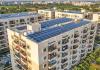
The challenge is particularly significant in urban India, where multi-storey buildings and apartment complexes accommodate large numbers of households.
The PM Surya Ghar framework also supports group housing societies and resident welfare associations for rooftop solar installations serving common facilities. Solar power can help reduce electricity expenditure on lighting, lifts and other shared amenities, potentially lowering maintenance costs for residents.
But solarising common facilities is not the same as extending the full benefits of rooftop solar to individual apartments. Lower common-area electricity bills do not automatically eliminate individual households’ electricity expenses.
If clean-energy access is to extend across different housing arrangements, policymakers must consider how solar generation can benefit individual residents as well as shared facilities.
Shared solar models offer one possible solution. Multiple households could benefit from a common installation rather than requiring each to control a separate rooftop. Their feasibility would depend on electricity regulations, metering arrangements, distribution infrastructure and mechanisms for allocating savings.
Policy Innovation
Making rooftop solar accessible to renters requires interventions that bridge the gap between eligibility and adoption.
First, tenancy-compatible installation arrangements need greater clarity. Standardised agreements between landlords and tenants could specify who finances the installation, owns the equipment, bears maintenance costs and receives the electricity savings. This would reduce uncertainty for both parties while protecting property owners’ rights.
Second, shared solar models deserve closer examination. Housing societies and eligible residential communities could explore common installations, while regulators assess how the resulting benefits might be allocated to individual households. Transparent billing, technical standards and clearly defined responsibilities would be essential.
Third, financing mechanisms must reflect different housing arrangements. Concessional financing can help eligible households meet initial installation costs, but credit alone cannot resolve the absence of rooftop access or landlord permission. Contractual arrangements allowing landlords and tenants to share costs and benefits over an agreed period could offer a way forward.
Finally, implementation data should measure access as well as installations. The number of subsidised systems is an important indicator of progress, but it does not reveal which housing groups face barriers. Voluntary, privacy-conscious data on housing tenure, building type and reasons for non-adoption could help identify where interventions are needed.
PM Surya Ghar represents an important effort to bring renewable energy generation closer to households. Its expansion also offers an opportunity to reconsider whether access to a benefit depends on circumstances that the policy does not directly address.
India’s next phase of rooftop solar expansion must therefore look beyond installations and electricity generation. It should examine who can participate, what prevents adoption and which alternatives are technically and economically viable.
(The writer is an economics postgraduate from Jawaharlal Nehru University with research interests in economic policy, trade and global governance. Views personal.)